





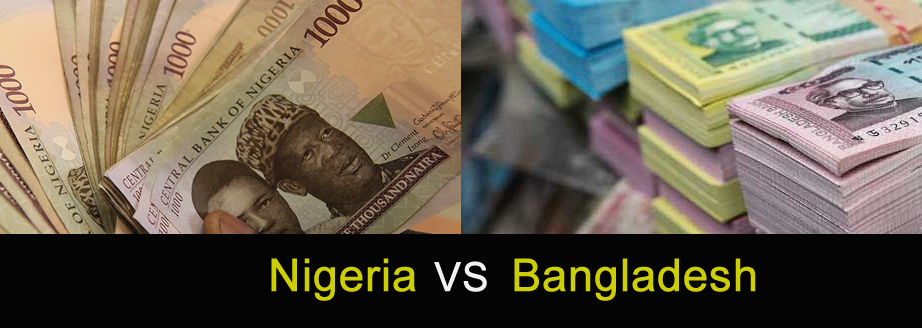
Nigeria and Bangladesh are both developing countries, each with its challenges. The politics and social fabric in both societies are highly complex with storied and blood-drenched histories. With a population of approximately 200 million and 165 million in Nigeria and Bangladesh respectively, both countries feature among the most highly populated nations in the world.


The challenges posed by a huge population in terms of jobs creation, skills development and empowerment, as well as robust resource mobilization to fund development resonates across both nations. Similarly, the two countries have a shared history marked by a prolonged period of political instability lasting decades post-independence.
Yet, in recent times, Bangladesh has been able to record significant economic progress, making laudable headway around industrialisation, growth, and competitiveness. Nigeria on the other hand remains wallowed in sub-par economic growth, with a business cycle and fiscal position that move in line with ever so volatile global crude oil prices. Unemployment is stubbornly high and rising, per capita GDP is retrogressing, manufacturing remains lackluster, and with critical underinvestment in essential infrastructure, Nigeria’s long-term potential remains severely challenged.
A quick Google search would reveal the starkly different economic narrative of the two countries: while headlines across major international press read along the lines of “The Rise and Rise of Bangladesh,” the Nigerian picture is the opposite, reflecting the comatose status of the country as the clichéd ‘Giant of Africa’ that is increasingly finding it hard to trudge along as it remains pulled down by the weight of its problems.
Nigeria’s Fourth Republic: A New Dawn?
The emergence of Nigeria’s Fourth Republic in 1999 was the beginning of a new era. Nigeria had withstood the test of time marked by a rollercoaster of fundamental socio-political and economic problems that had challenged the country’s very existence, and was able to segue into a nascent democracy with renewed hopes going into the new millennium. Following this transition, Nigeria embarked on a series of reforms that yielded tangible improvements in economic outcomes, and significantly improved the macroeconomic environment in the country. More prudent fiscal management encouraged national savings and improved macroeconomic stability. In setting the fiscal budget, the government jettisoned the market-price of crude-oil approach and adopted the benchmark oil-price approach – where fiscal spending is predicated on a predetermined oil-price and production level for the year – a significant reform which helped put the lid on government expenditure. Oil receipts above the benchmark were to be saved in the Excess Crude Account (ECA), a contingency fund designed to create a buffer during periods of commodity shock to oil revenues. Nigerian authorities also negotiated a historic debt relief with multilateral lenders, leading to the Paris Club agreement which reduced Nigeria’s overall debt stock by $18 billion in 2005.
The watershed deal provided vital policy space for Nigeria, giving the country much-needed fiscal room to fund long-term development. The Fiscal Responsibility Act enacted in 2007 institutionalised key reforms ensuring sustained fiscal discipline. The government also pushed ahead with a number of pro-growth reforms which helped diversify the GDP away from crude-oil and gave rise to other vibrant sectors in the economy. One of the most noteworthy being the liberalisation of the telecommunications industry, which paved the way for productive private investments leading to a remarkable transformation in the industry. The bank consolidation exercise in 2004 equally created a more robust, stronger banking sector, resulting in improved financial intermediation and financial inclusion. While the political stability achieved alongside strong macroeconomic reforms resulted in high growth rates in the Nigerian economy, with GDP growth averaging 7.1% between the periods of 1999-2010, compared to a paltry 1.7% achieved during military rule between 1983 and 1999, Nigeria was unable to translate these gains in the macroeconomy into substantial improvement in living standards and development outcomes. Poverty remained stagnant, and growth was not inclusive.
Bangladesh: Still a Shaky Political Regime
While Nigeria’s return to democracy at the turn of the century ushered in a new era of political stability – leaving behind the prior decades’ instability of military rule, the shift in Bangladesh to a stable political regime has been patchy.
Following nearly two decades of military rule ending in 1990, a non-elected, non-partisan caretaker government was put in place to manage the transition to democratic rule, and the country subsequently held a general election in 1991, adopting the parliamentary system. However, since the transition away from authoritarian military rule, consolidation of democracy in Bangladesh remained lacklustre, with the country’s political structure being labelled a hybrid regime – combining elements of both a democracy and autocratic rule.
Although the caretaker government was initially intended as a one-off intervention to manage the transition to democratic rule, the system became institutionalised in the mid-1990s as elections were highly fraught, and marked with violence. The caretaker system remained in place up until 2011, when the country devolved into a political crisis involving military interventions in 2006-2008. In 2015, another political crisis escalated, due to turmoil between the two main political parties, following the controversial 2014 general elections, with the opposing party demanding for a return to the caretaker system.
The economic condition in the country over the period of instability remained bleak, and it wasn’t until 2006 that Bangladesh began its economic ascent, which at the time was dismissed as a fluke.