
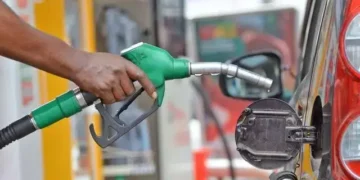
Petrol consumption in the country jumped from 55.59 million litres a day in April to 72.07 million litres per day in the month of May.

This shows that in the month of May, petrol consumption in the country was 16.48 million higher than the consumption in the month of April.
This also means that within the period, the country’s daily consumption of petrol by 29.65 per cent between April and May.

Data obtained from the Nigerian National Petroleum Corporation monthly report showed for the first five months of the year, the corporation supplied a total of 8.76 billion litres for local consumption.
The Federal Accounts Allocation Committee report also showed that the country pumped N541.66bn into petrol subsidy in the first six months of the year.
The NNPC supplied a total of 8.76 billion litres in the first five months of the year.
Petrol supplies hit a high of 72.3 million litres per day in May. According to the NNPC, 2.241 billion litres (72.3 million litres per day) of white products were sold in the month of May 2021. In April, 1.673 billion litres were sold (55.77 million litres per day).
This means that from April to May 2021, petrol consumption jumped by 568 million. In March, the NNPC said 1.75 billion litres (56.45 million litres per day) of Premium Motor Spirit was consumed.
In February it said consumption was 1.41 billion litres (50.36 million litres per day). In January 2021, 1.68 billion litres (54.27 million litres per day) of PMS were supplied.
According to the NNPC, the total revenues generated from the sales of PMS between May 2020 and May 2021 is N2.34tn. The corporation added that total sales of petroleum products for the period May 2020 to May 2021 was 18.651billion litres, with PMS accounting for 99.69 per cent of total volume.
Before Major General Muhammadu Buhari (retd), became president Nigeria’s petrol consumption was estimated at between 35 million to 40 million litres daily.
In a February 8, 2018 statement, the NNPC said the country’s daily petrol consumption was around 35 million litres.
The rise in the quantity of fuel consumed in the country has also meant an increase in what NNPC calls under-recovery – a euphemism of petrol subsidy.
According to the NNPC books, the subsidy was not recorded in January. In February, the NNPC paid N25.37bn as subsidy. In March, it paid N 60.39bn. In April, it paid N61.97bn as a subsidy. In May, it paid N126.29bn as subsidy. In June subsidy rose to N164.34bn. In July, the subsidy paid by the corporation amounted to N103.29bn. The corporation paid N541.66bn as a subsidy in the six months under review.
Group Managing Director of the NNPC, Mr Mele Kyari, had recently blamed the rising figures in fuel consumption in the country on the smuggling of products to neighbouring countries.
The Chief Executive Officer and Executive Secretary, Major Oil Marketers Association of Nigeria, Mr Clement Isong, said several reasons could be responsible for the increase in petrol consumption in the country.
“The number that you have is not sales in the stations; it is load-out from the jetties – that is what they track. So, the first reason and the most obvious and saddest reason is that not all the products may go to stations; some may be smuggled out of the country,” he said.
He attributed the cause of petrol smuggling to the policy that made petrol pump prices ‘significantly lower than those in neighbouring countries.
“It is not unusual for it to happen, and the solution is proper pricing of the product. I don’t think our consumption is as high as 70 million litres per day,” he added.
The National Operations Coordinator, Independent Petroleum Marketers Association of Nigeria, Mr Mike Osatuyi, said the collaboration between the NNPC and the Economic and Financial Crimes Commission might have brought about a reduction in petrol smuggling.
“Smuggling is responsible for the increased in petrol consumption; we are the one serving neighbouring countries, but because of control measures put in place, smuggling may have gone down.”