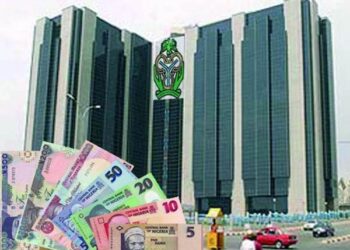








For failing to meet the 32.5 percent Cash Reserve Requirement (CRR) threshold, the Central Bank of Nigeria (CBN) debited 10 banks N1.62 trillion in the first six months of 2023, THISDAY investigations have revealed.

The 10 banks are Zenith Bank Plc, United Bank for Africa (UBA), Guaranty Trust Holding Company Plc (GTCO), and FBN Holdings Plc.
Others were: FCMB Group Plc Fidelity Bank Plc, Stanbic IBTC Holding Plc, Wema Bank Plc, Sterling, and Unity Bank Plc.
CRR is the minimum amount banks and merchant banks are expected to retain with the CBN from customer deposits and it carries no interest and is not available for use by the banks in their day-to-day operations.
Today’s analysis of the banks’ results and accounts for the period ended June 30, 2023, showed that the 10 banks’ mandatory reserve deposit with the Central Bank in the 2022 full financial year stood at N9.11 trillion compared with N7.49 trillion reported as of June 30, 2023.
Today’s investigation revealed that within the first six months of 2023, the apex bank debited the 10 banks an estimated N1.62 trillion.
Today gathered that Zenith Bank’s restricted deposit with CBN added N580.49 billion in six months when it closed June 30, 2023, at N2.25 trillion from N1.67 trillion in 2022 FY.
UBA followed Zenith Bank with about N356.37 billion debited by the CBN in the first six months of 2023 to N1.64 trillion from N1.28 trillion reported in 2022 FY.
GTCO’s mandatory deposit with CBN reached N1.22 trillion, representing an increase of N208.5 billion from N1.01 trillion in 2022.
On its part, FBN Holdings closed the period under review with N199.91 billion added to its mandatory reserve deposit with the Central Bank.
“Despite the pressure from competition and the need to cover for regulatory CRR debits, the Group maintained an average liquidity ratio of 36.6% during the period under review,” GTCO explained in a presentation.
FBN Holdings closed June 30, 2023, with N1.76 trillion mandatory reserve deposit with Central Bank from N1.56 trillion in 2022.
Unity Bank was the only Tier-II bank that reported N3.66 billion mandatory reserve deposits with Central Bank to N69.05 billion as of June 30, 2023, from N72.71 billion reported in the 2022 full financial year.
Hitherto, analysts had called on the CBN to consider reducing the CRR for banks from 32.5 percent to 25 percent in view of the high monetary policy rate (MPR).
The Monetary Policy Committee (MPC) of the CBN last September increased CRR from 27.5 percent to 32.5 percent in a move to tame inflationary pressure.
Analysts explained to THISDAY that the recent debiting from commercial lenders has become frequent as the CBN is trying to curb speculation against the local currency as the country’s foreign exchange reserves continue to drop.
Fitch Ratings, a global rating agency has said that banks are facing tough times due to CRR policy limiting their capacity to grant loans to customers.
“The CBN has been highly interventionist,” said Mahin Dissanayake, Senior Director for Europe, Middle East and Africa bank ratings at Fitch.
“Where peers like South Africa and Kenya followed the global trend of giving banks more room to lend, Nigeria hasn’t budged. Instead, it stuck with a CRR that compels lenders to keep a portion of their deposits with the regulator.
“Failure to meet the threshold results in the regulator debiting banks’ accounts with the shortfall. The central bank also dips into the accounts when lenders fail to extend 65 percent of their deposits as loans, a measure that was introduced to stimulate credit. The rules “are aimed at two different monetary policies,” he said, adding, “They are conflicting.”
Speaking, the Vice President, of Highcap Securities Limited, Mr. David Adnori said the apex bank is using CRR to control inflation, stressing that the introduction of CRR is a drastic monetary policy targeted at controlling the money supply in the banking system.
According to him: “If CBN fails to maintain its CRR policy, so much money will flow into the market and further deprecate the naira. Generally, the policy has not favored banks because the fund is not yielding any interest and is of no benefit to the productive sector.
“These are funds banks lend to the real sector to drive business activities, finance working capital of productive industry, and boost GDP but the CBN is holding it down.
“It is not a good development for the nation’s economy in general. However, the CBN has its reasons, and releasing these funds might result in hyperinflation, which can damage the nation’s economy. It is like a double edge situation- if you don’t do it, the economy is damaged and if you do it, the economy also struggles.”
He noted that the only way CBN can cut CRR is when inflation drops to a single-digit rate.
Analysts at Agusto & Co in a report said the CBN’s policies targeted at lowering interest rates have persisted especially given the dire need to stimulate the economy following adversities created by the pandemic.
According to Agusto & Co., “It is noteworthy that Nigeria has the highest reserve requirement in sub-Saharan Africa. South Africa, Kenya, and Ghana all have CRRs of below 10per percent. We believe the elevated CRR level moderated the Industry’s performance and liquidity position during the year under review.”