








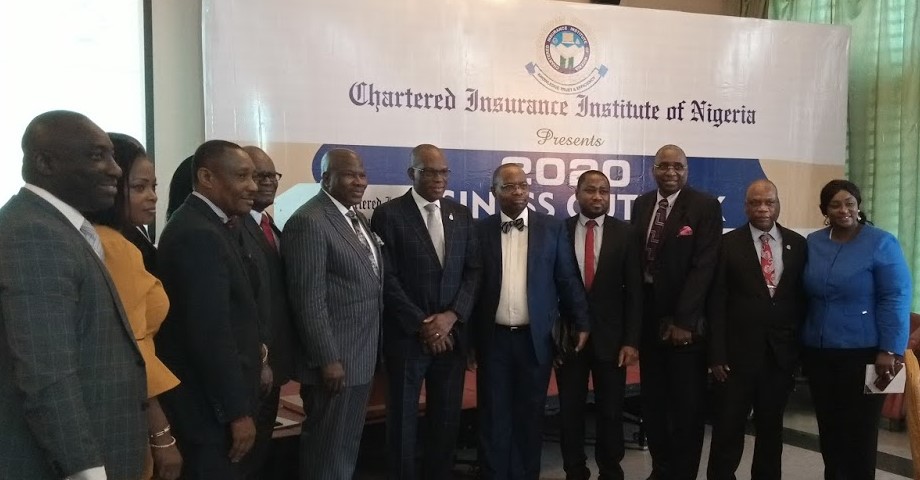
Experts have taken a critical look into the macroeconomic environment in 2020, x-raying the challenges and opportunities, as well as how insurers can key in to grow their business.

According to the experts, whether for individual or businesses, 2020 present its own challenges and this could be looked at from different trends and themes.
Sunday Thomas, acting commissioner for Insurance/CEO, National Insurance Commission (NAICOM) speaking earlier at the 2020 Business Outlook Seminar organized by the Chartered Insurance Institute of Insurance (CIIN) held in Lagos said the seminar has been a veritable platform for the insurance industry to review, analyze and project the potential of the economy and the impact of the federal government budget on insurance business.
Thomas noted that choice of this year’s main theme ‘Economic Policies of the Government in 2020: Issues, Challenges & Prospects’, and it’s discuss is expected to open the areas of opportunities where the industry can play to deepen its market.
According to him, he Commission is committed to sustainable growth in order to enhance the stability of the Insurance Industry in Nigeria. “We therefore invite the insurance sector to maximize the opportunities inherent in the 2020 Federal Government budget of sustainable growth and job creation whilst also ensuring seamless transition to the new capital regime of the Industry.”
Oladimeji Alo, managing director/CEO, Excel Professional Services Ltd, presenting the lead paper, and quoting GTBank 2020 Economic Outlook document, identified five major themes and trends to watch out for in 2020.
Among the themes according to the him include- Fiscal policy of government as reflected in the 2020 FGN Budget; Nigerian’s Debt Profile; Interest Rate and Inflation; Exchange Rate Policy, External Resources and Capital Flows; and Oil Prices, Production And Security
Oladimeji Alo noted that while insurers will battle to get their own fair share of the economic wealth, it has its internal challenges that would not be taken for granted.
Among the issues he listed include – cultural beliefs and practices that do not support insurance; Poor claim management experience of many policy holders; low contributions to GDP; low level of insurance penetration that stood at 1.6 percent in 2019; A large number of operations (58) many of whom are fringe players; weak capital base of many of the players, relative to the risk they underwrite; Inadequate skills in some critical areas for instance actuaries; relatively poor showing of the sector in the capital market; as well as the fast – approaching deadline for re-capitalization in the sector (Dec. 2020).
On Fiscal Policy, Alo identified challenges for insurance to include that VAT increase might impact the disposable income of the people negatively; Cost of goods and services might go up; failure of government to meet its revenue expectation might further worsen the other economic variables; as well as considerable focus of attention on issues of capital raising mergers and acquisitions.
But on opportunities for the insurers, he said there will be improvement in the results of insurance companies on account of the tax reforms in the Finance Act.; Government investment in major infrastructure projects could mean more business for some insurance companies; Improved performance of the sector might make the sector more attractive to new investors; Improved fortune of MSMES might mean more business for the sector;’ Fewer and stronger firms might emerge; an further consolidation of the sector could lead to better performance for some players.
On debt profile, Alo observed that while this could a major constraint on government expenditure and ability carry out projects, if well executed could boost insurance growth.
“If properly expended on infrastructure projects as planned, the new debt could spur growth in the economy which the insurance sector could benefit from. As previously noted, some insurance companies could benefit directly from providing cover to activities around some of the major projects.”
On exchange rate, he said a stable exchange rate would present insurance companies a favourable environment to plan and execute their initiatives.
For oil prices, production and security, he noted that an improvement in the price of crude oil above the benchmark would boost the revenue of the government.
“Relative peace in the oil producing areas and a major reduction of disruption of production activities would be quite helpful in meeting production targets.”
According to him, success in the battle against insurgents and normalization of economic activities in the affected areas would greatly boost the performance of insurance companies.
Concluding, Oladimeji Alo observed that the insurance firms that would do well in 2020 are those who had invested in their Brand equity; Innovation capabilities; Talent management capabilities; Information technology resources and capabilities.
While individual firms would do well to pay attention to these critical areas in 2020, the expert observed.